Part 1
Working at Milo's Restaurants
ANNOUNCER: Part 1. You will hear a woman from a job agency giving information to a man about work in a chain of restaurants. First, you have some time to look at questions 1 to 5. Now listen carefully and answer questions 1 to 5.
WOMAN: So, I understand you're interested in restaurant work.
MAN: Yes, I've got a bit of experience, and I can provide references.
WOMAN: That's good. I can check all that later. Now, Milo's restaurants have some vacancies at the moment. They're a really good company to work for, with lots of benefits.
MAN: Oh right.
WOMAN: Yes, they've got a very good reputatio
for looking after staff. For example, all employees get training, even temporary staff.
MAN: Oh really? That's quite unusual, isn't it?
WOMAN: Certainly is.
MAN: And do staff get free uniforms too?
WOMAN: Um. You just need to wear a white T-shirt and black trousers, so probably not. But another benefit of working for a big company like this is that you can get a discount at any of their restaurants.
MAN: Even at weekends?
WOMAN: No, but you'll be working then anyway.
MAN: Oh yes, I suppose so. Most of their restaurants are in the city center, aren't they? So they're easy to reach by bus.
WOMAN: Yes, that's right. But if you finish a late shift after midnight, the company will pay for a taxi home.
MAN: I probably won't need one. I'd use my bike.
WOMAN: OK. Now they have some quite specific requirements. Milo's is a young dynamic company, and they're keen on building a strong team. It's important that you can fit i
and get on well with everyone.
MAN: That's fine. The last place I worked was quite demanding too. We had to provide a very high level of service.
WOMAN: That's good, because that's equally important at Milo's. They want people who have an eye for detail.
MAN: That's fine. I'm used to that kind of environment.
WOMAN: Perfect. The final requirement is good communication skills. You'll need a certificate in English.
MAN: Sure.
ANNOUNCER: Before you hear the rest of the conversation, you have some time to look at questions 6 to 10. Now listen and answer questions 6 to 10.
WOMAN: Let's look at the current job vacancies at Milo's. The first one is in Wivenhoe Street.
MAN: Sorry, where?
WOMAN: Wivenhoe — W I V E N H O E. It's quite central, just off Cork Street.
MAN: Oh right.
WOMAN: They're looking for a breakfast supervisor.
MAN: That would be OK.
WOMAN: Responsibilities include checking portions and ensuring cleaning procedures are followed.
MAN: And what about the salary? In my last job I earned £9.50 per hour.
WOMAN: You'd start at £9.75, increasing to £11.25 after three months.
MAN: That's not too bad.
WOMAN: The only drawback is the early start. Breakfast begins at 7:00 am, so you'd start at 5:30 am and finish at 12:30 pm.
MAN: I see.
WOMAN: Another vacancy is at the City Road branch. That's for a junior chef.
MAN: I might prefer that.
WOMAN: You would assist the sous chef and senior staff, manage stock, and organize deliveries.
MAN: I've never done that before.
WOMAN: You'll work with experienced staff first. The salary is £23,000 per year.
MAN: OK.
WOMAN: If they like you, there's a good chance of promotio
. The hours include evenings and weekends, but the restaurant is closed on Mondays. You also get one Sunday off every four weeks.
ANNOUNCER: That is the end of Part 1. You now have one minute to check your answers.
Part 2
Housing Development
ANNOUNCER: Part 2. You will hear a talk to members of the public about plans for a new housing development near a town called Nunsto
. First, you have some time to look at questions 11 to 14. Now listen carefully and answer questions 11 to 14.
MARK REYNOLDS: Hello everyone. It's good to see that so many members of the public have come to our presentation about the new housing development planned on the outskirts of Nunsto
. I'm Mark Reynolds, the Communications Manager for the project.
MARK REYNOLDS: I'll start with a brief overview of our plans. One question people often ask is why we chose this particular site for development. At the moment the land is used for farming, like much of the land around Nunston.
MARK REYNOLDS: However, because of the new industrial center in Nunston, there is a high demand for housing for employees in the area. At present many workers must commute long distances.
MARK REYNOLDS: There is also an international airport only 20 minutes away by car. Although this is convenient, it was not one of the main selection criteria for the site.
MARK REYNOLDS: More important for us was the fact that there is an excellent hospital only 15 km away and a large secondary school even closer.
MARK REYNOLDS: One disadvantage of the site is that it lies on a fairly steep slope. However, we have considered this carefully in our planning, so it should not cause major problems.
MARK REYNOLDS: We have received a lot of positive feedback about the development plans. People particularly like the variety of housing types and price ranges.
MARK REYNOLDS: Many people also appreciate that it will only take a short drive to reach the surrounding countryside.
MARK REYNOLDS: We were pleased that so many people liked the layout desig
of the development. Most said it made a good overall impressio
and blended well with the natural landscape.
MARK REYNOLDS: The plan also includes protection for trees and wildlife on the site.
MARK REYNOLDS: Some people suggested adding more cycling facilities, which we will consider. Overall, however, people believe the development will create a community where people of all ages can live comfortably together.
ANNOUNCER: Before you hear the rest of the talk, you have some time to look at questions 15 to 20. Now listen and answer questions 15 to 20.
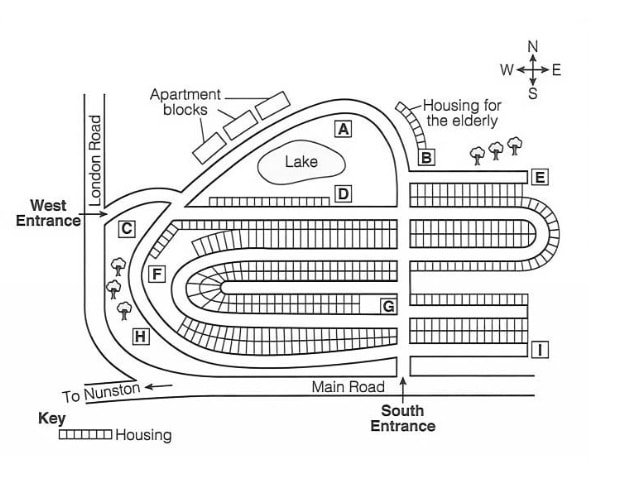
MARK REYNOLDS: I'll now show you a map of the proposed development. The area is bordered on the south by the main road leading to Nunston. Another boundary is formed by London Road.
MARK REYNOLDS: On the western side of the development there will be around 400 houses and three apartment blocks.
MARK REYNOLDS: There will also be a primary school for children up to the age of 11. This will be located on the main road that runs through the development, at the second left turning.
MARK REYNOLDS: A large sports center with both indoor and outdoor facilities will be located on the western side, just below the road branching from London Road.
MARK REYNOLDS: There will also be a medical clinic. If you look at the lake near the top of the map, the clinic will be just below it, to the right of a street of houses.
MARK REYNOLDS: A community center will also be built. On the northeast side there will be houses for residents aged over 65, and the community center will be next to them.
MARK REYNOLDS: There will be a supermarket between the two entrances to the development.
MARK REYNOLDS: The three large trees near London Road will remain, and a playground for younger children will be built just south of them.
MARK REYNOLDS: The playground will be located in the curve of the road near the top of the development and will have views of the lake.
ANNOUNCER: That is the end of Part 2. You now have 30 seconds to check your answers.
Part 3
Laki Eruption
ANNOUNCER: Part 3. You will hear two geography students, Adam and Michelle, talking about a volcanic eruptio
which took place in Iceland in 1783. First, you have some time to look at questions 21 to 26. Now listen carefully and answer questions 21 to 26.
ADAM: So, Michelle, shall we start our presentatio
? We haven't got much time left.
MICHELLE: True, Adam, but at least we've finished all the background reading. I found it really interesting. I'd never even heard about the Laki eruptio
before.
ADAM: Me neither. I suppose 1783 was quite a long time ago.
MICHELLE: Yes, but it was a massive eruptio
, and it caused extremely devastating consequences.
ADAM: I know. It was helpful that there were many primary sources. They really show how catastrophic the volcano was.
MICHELLE: Exactly. People were trying to understand the science behind it for the first time.
ADAM: Yes, but what interested me more was how the eruption influenced political events, as well as social and economic consequences.
MICHELLE: Right. That should probably be the main focus of our presentation.
ADAM: The observations made at the time were really interesting too.
MICHELLE: Yes, they all gave fairly consistent accounts of what happened, even though they used different terminology.
ADAM: I was surprised there were already so many weather stations then. You can see how the weather changed almost hour by hour.
MICHELLE: Yes. Writers described something called the Laki haze, which was a kind of volcanic fog spreading across Europe.
MICHELLE: They realized it was different from normal fog because of the sulfur smell, which people hadn't experienced before in pre-industrial times.
ADAM: That's true.
MICHELLE: Reports blamed the haze for increased headaches, respiratory problems, and asthma attacks. It also made the sun appear red.
ADAM: That must have been very strange.
MICHELLE: Interestingly, Benjamin Frankli
wrote about the haze. He was the American ambassador in Paris at the time.
ADAM: At first, nobody realized the haze came from a volcanic eruptio
in Iceland.
MICHELLE: Benjamin Franklin was the first to suggest that.
ADAM: Although actually a French naturalist identified it earlier. Later, several naturalists reached the same conclusion independently.
MICHELLE: We should also discuss the immediate impact of the eruption, especially in Iceland, where many people died.
ADAM: Yes, and the volcanic ash spread very quickly. The effects lasted for a long time.
ADAM: Even two years later, unusual weather events were reported in North America and North Africa.
MICHELLE: Yes, and people couldn't do anything to stop the ash cloud, even if they knew it was coming.
ANNOUNCER: Before you hear the rest of the discussion, you have some time to look at questions 27 to 30. Now listen and answer questions 27 to 30.
MICHELLE: Let's review the terrible consequences in different countries.
ADAM: Starting with Iceland, where the eruption had a devastating effect on farming.
MICHELLE: Yes. Livestock were poisoned because they ate plants contaminated with fluorine from the volcanic fallout.
ADAM: In Egypt, unusual weather patterns caused a severe drought. As a result, the Nile didn't flood and crops failed.
MICHELLE: That led to a terrible famine where more people died than in any other country.
ADAM: In the UK, the mortality rate increased significantly, possibly because of respiratory illnesses.
MICHELLE: Apparently the number of deaths was nearly double the usual amount, especially among people under 25.
ADAM: Even the USA experienced unusual weather. George Washingto
wrote in his diary that Virginia remained snowbound until March.
MICHELLE: And there was even ice floating down the Mississippi River, which had never happened before.
ADAM: That's really astonishing.
ANNOUNCER: That is the end of Part 3. You now have 30 seconds to check your answers.
Part 4
Pockets
ANNOUNCER: Part 4. You will hear a student on a fashion design course giving a talk about the history of pockets. First, you have some time to look at questions 31 to 40. Now listen carefully and answer questions 31 to 40.
SPEAKER: Good morning. We were asked to choose an aspect of European clothing or fashio
and talk about how it has developed over time. I decided to focus on a small part of clothing — pockets.
SPEAKER: I chose pockets for two reasons. First, we all have them in jeans, jackets, and coats. Even though we carry bags or briefcases, nothing is as convenient as putting your phone or credit card into your pocket.
SPEAKER: However, people rarely think about pockets as a fashion item. They are often overlooked. But when we look back in history, the development of pockets for me
and wome
is quite fascinating.
SPEAKER: In the 18th century, fashion was very different. For men, this was when suits became popular. Trousers were knee-length and were called breeches. Waistcoats were short and jackets were long.
SPEAKER: These garments were lined with material, and pockets were sewn into the lining by the tailor. The wearer could store small items such as coins or pencils and reach them through a gap in the lining.
SPEAKER: Later, coat pockets became more decorative for fashionable men. However, they were often larger and plainer for professionals who needed to carry tools, such as doctors carrying medical instruments.
SPEAKER: The development of women's pockets was quite different. They were not as visible or as accessible as men's pockets.
SPEAKER: In the 18th and 19th centuries, women often carried many valuable possessions. They were more vulnerable to pickpockets, so they needed to keep items hidden.
SPEAKER: Women had a pair of pockets made and tied them around their waist with string. The pockets were made from fabric, sometimes from recycled cloth or from more expensive materials such as line
, often decorated with embroidery.
SPEAKER: These pockets were worn beneath their clothes. Since skirts were long, there was space to hide items between layers of petticoats. Women could reach them through a small opening in the skirt.
SPEAKER: Working wome
also carried tools for their trade. Their pockets remained inside their clothing but became larger, sometimes reaching down to their knees.
SPEAKER: These tie-on pockets remained common until the late 19th century. When fashion changed, dresses became tighter and less bulky.
SPEAKER: As a result, the pockets became too visible and affected the woman's appearance. Women still needed to carry personal items, so small bags or pouches became fashionable.
SPEAKER: These eventually developed into the modern handbag, especially when pockets disappeared from women's clothing.
ANNOUNCER: That is the end of Part 4. You now have one minute to check your answers to Part 4.
Questions 1-5
Complete the notes below.
Write ONE WORD ONLY for each answer.
Working at Milo's Restaurants
Benefits
Person specification
Fill the blanks in the question/table above.
Questions 6-10
Complete the table below.
Write ONE WORD AND/OR A NUMBER for each answer.
Fill the blanks in the question/table above.
Questions 11 and 12
Choose TWO letters, A-E.
11-12 What are the TWO main reasons why this site has been chosen for the housing development?
11-12 What are the TWO main reasons why this site has been chosen for the housing development?
Questions 13 and 14
Choose TWO letters, A-E.
13-14 Which TWO aspects of the planned housing development have people given positive feedback about?
13-14 Which TWO aspects of the planned housing development have people given positive feedback about?
Questions 15-20
Label the map below.
Choose the correct letter, A-I, next to Questions 15-20.
16 16 Sports centre
18 18 Community centre
Questions 25 and 26
Choose TWO letters, A-E.
25-26 Which TWO issues following the Laki eruption surprised the students?
25-26 Which TWO issues following the Laki eruption surprised the students?
Questions 27-30
What comment do the students make about the impact of the Laki eruption on the following countries?
Choose the correct letter, A-F, next to Questions 27-30.
A. This country suffered the most severe loss of life
B. The impact on agriculture was predictable.
C. There was a significant increase in deaths of young people.
D. Animals suffered from a sickness.
E. This country saw the highest rise in food prices in the world.
F. It caused a particularly harsh winter.
Questions 31-40
Complete the notes below.
Write ONE WORD ONLY for each answer.
Pockets
Pockets
Reason for choice of subject
Pockets in men's clothes
Pockets in women's clothes
Fill the blanks in the question/table above.